Daniel Posmik
I am a PhD student in the Department of Biostatistics at Brown University, advised by Ani Eloyan. My research focuses on manifold learning and topological data analysis methods for biomedical imaging data, with emphasis on neuroimaging applications. More broadly, I am excited about large-scale inference problems where geometry, shape, and network structure play a central role. Previously, I spent my time thinking about causal inference.
Beyond research, I am an avid bikepacker, urbanist, and lover of dogs. If you are interested in having a chat on any of the above, please do not hesitate to reach out to me at daniel_posmik[at]brown[dot]edu.
Research Interests
I am currently developing model-based uncertainty quantification for manifold estimation, motivated by neuroimaging problems where uncertainty is spatially structured.
Selected Publications
Predicting International Student Enrollment by Institutional Aid: A Random and Fixed Effects Approach
Journal of Student Financial Aid / 2022
Predicting International Student Enrollment by Institutional Aid: A Random and Fixed Effects Approach
Journal of Student Financial Aid / 2022
Abstract
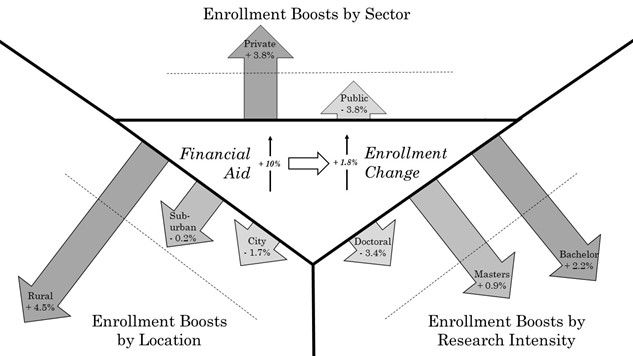
Since the fall semester of 2016, first-time international student enrollment (ISE$_{\mathrm{ft}}$) has declined at U.S. colleges and universities. This trend disrupts a steady upwards trajectory of ISE$_{\mathrm{ft}}$ rates. Previous research has demonstrated that various political, social, and macroeconomic factors influence the number of international students studying in the U.S. Exploiting data from the Common Data Set (CDS), I focus on the role financial aid plays as an enrollment predictor for international undergraduate students. A fixed effects model reveals that financial aid is strongly and significantly predictive of ISE$_{\mathrm{ft}}$, yielding a 1.8% enrollment increase per 10% aid increase, all else equal. Interestingly, financial aid is only predictive of ISE$_{\mathrm{ft}}$ if it is awarded in substantial amounts. Extending the work of Bicak and Taylor (2020), I also analyze how the effectiveness of financial aid awards varies within different institutional settings. Random effects regressions reveal that rural, low research, and private universities experience considerable marginal ISE$_{\mathrm{ft}}$ boosts when awarding aid to international students. The findings of this work are primarily directed at institutional leaders who seek to revitalize their institution's ISE$_{\mathrm{ft}}$ policy. Moreover, these insights may inform local policymakers who seek to incent ISE$_{\mathrm{ft}}$.
[PDF]